Music as Medicine: How Music Can Enhance Clinical Outcomes with Mei Rui
Join Dr. Mei Rui as she explores the groundbreaking Music-in-Medicine program at MD Anderson. Mei shares how music is used to transform patient care, boost surgical performance and promote overall wellness. Discover the science behind music medicine, from live and recorded interventions to the impressive results seen in patients and healthcare providers. Learn how music is revolutionizing healthcare, reducing stress, speeding up recovery and creating true healing.
This talk was recorded at Summit Baja in November 2024.
About the Presenter
Our Brains on Music: A live brain mapping experience with Mei Rui
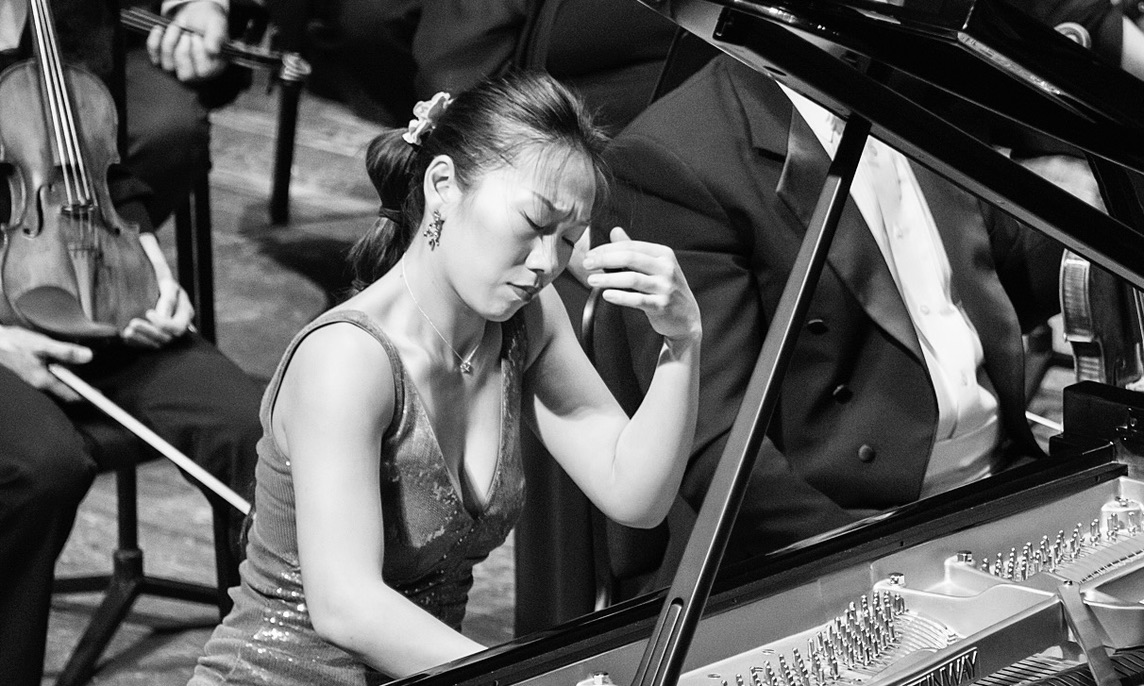
This groundbreaking interactive experience between you, a computer and a piano, maps stimulated brain function with live visual data that redefine the boundaries of human cognition. Mei Rui is a pioneer in music medicine, founder and director of Music-in-Medicine at MD Anderson and Assistant Professor of Neurosurgery.
Transcript
Welcome to the stage: concert pianist, director of Music and Medicine, and assistant professor in the Department of Neurosurgery at the University of Texas MD Anderson Cancer Center, Dr. Maie Beyrau.
Good evening. Thrilled to be here with you all this evening, and thank you for choosing to be here instead of taking a beautiful walk on the beach right now.
So tonight we're going to explore the development, the clinical applications, the scientific basis, and also recreational uses of a very powerful anti-inflammatory, brain-nourishing drug. This drug, in critically ill ICU patients, has been shown to reduce at serum level and plasma level a big reduction in stress biomarkers and cytokines — these are stress hormones and molecules you may be familiar with, like cortisol, interleukins, and other smaller cytokines that course through your blood when your body is under a lot of stress.
Just 30 minutes of exposure to this particular drug — and I'll explain a lot more, because this drug is very heterogeneous — has been shown to significantly reduce stress biomarkers. In stroke survivors, this drug has been shown to promote neurological recovery and help repair regions in the brain that have been damaged, as well as bring extra oxygenated blood flow to critical brain regions. In providers — in physicians and other workers in acute care environments — this drug has been shown to enhance surgeon performance and help harmonize the dynamics inside of an OR.
And at MD Anderson Cancer Center, we're exploring using this drug to help reduce pain, to modulate the physiological stress response in perioperative and intraoperative cancer patients. I'm leading and spearheading multiple clinical trials to quantitatively assess the impact of both bedside music intervention as well as immersive live performances inside the number one cancer hospital in the US.
So by now, most of you have guessed: this drug is music.
So most of us know music is a powerful modulator of our mood. It can stimulate, just after a few seconds of exposure, a cascade of neurotransmitter releases such as dopamine, endorphins, oxytocin, and serotonin, depending on the particular music and acoustic stimuli. But the therapeutic impact goes way beyond something that may just make you feel good.
There is an emerging field of music medicine, which NIH actually recognizes as a separate field from music therapy. Music medicine is very quantitative. We harness a lot of state-of-the-art technology — neuroimaging using fMRI and EEG, which I'm going to show you in a later performance tonight where we'll be doing live brain-computer mapping during the concert. You'll be able to see region-specific activation through the performer's side and also through a volunteer audience member's side. So if anybody may be interested in becoming that volunteer later, I see some hands up already — please come talk to us afterwards.
So here's a little overview of what we will cover in the next 45 to 50 minutes. I'm going to give you a brief overview of the background and field of music and medicine and tell you a little bit about the program — what we're doing at MD Anderson, which has both a very rigorous clinical trial research component and is very multidisciplinary. All the studies are multimodal. We collaborate with neuropsychologists, neuroimaging — I collaborate with Grammy-winning composers, professional musicians. So it's really an amazing time to be in this emerging field.
Then I want to share with you one of our exciting studies titled "Your Brain on Music," and I will show you through data and demonstration why live music is superior to listening to a recording or attending a virtual concert online, which became very necessary and popular during the pandemic. Additionally, I'll go over harnessing the intrinsically healing properties in classical music — specific compositional elements that we isolated and identified — and how we created a reproducible and scientifically rigorous framework that could be used for future music intervention trials and studies. I'll cover how we harness music as a powerful anxiolytic — an anxiolytic being a non-pharmacological medication that reduces physiological stress — and how we use it to mitigate pain as well.
In one of our intraoperative studies, we look at the impact of music on pain and physiological stress, plus mindfulness on the surgeon side, and outcomes like hope and change in mood states in cancer patients. Then I'm going to share a study we did where we found critical parallels between musical and surgical performance. I work with about 16 neurosurgeons in my department — I'm not a neurosurgeon myself, I'm on the research side — but there are actually a lot more commonalities than may be intuitive to the general public. I'll also cover how music may have potential side effects, especially in fragile situations — for example, in the ER or inside an operating room where your surgeon may be playing very activating, stimulating death metal or heavy techno, which may help them get into the flow, but data has shown it could cause serious side effects like arrhythmia in patients undergoing cardiovascular surgeries. Even patients under general anesthesia — their body still responds through entrainment to the impact of the music. And then I'll finish with a few future directions where I hope and envision this field to be headed.
I want to start with an example. This is one of our large-scale clinical trials — a really groundbreaking study. It's very multimodal. We're using proteomics and metabolomics to look at blood before and after a 30-minute-long music intervention, and how a preoperative neurosurgical patient may benefit from a type of music intervention that integrates compositional elements of relaxation.
Every piece of music we use for the study is very controlled, especially the genre of classical music. It's complex, very heterogeneous, and a lot of music therapists even shy away from using classical pieces, for a few reasons. Without decades of training, it's hard to tell which of the Mozart sonatas, which of the Chopin nocturnes, which sections of a particular piece may be suitable to target a desired clinical outcome — whether it's to rejuvenate, promote sleep, or help reestablish the circadian rhythm in ICU patients. Being very mindful and specific about the desired clinical outcome is really critical to success.
So we record all of our music for our studies, and a lot of times we modulate the compositional elements. For example, a Chopin nocturne is a beautiful piece at a slow tempo, but it may have a very eruptive, acute climax that may raise the patient's blood pressure and heart rate. So we record in a way to adapt and control for these variables. I encourage you to read a little more about our trials — I'll share the website at the end of the talk.
Using music as a medicine — I have a personal confession to make. I have performed around the world as a pianist. I have performed a lot more concerts than I've given talks. I started performing at a very young age on the concert stage — I started piano when I was 3 years old, and my first solo concert, a one-hour recital, was when I was 10 and a half, in front of the president of Austria. So I've been very comfortable performing on stage, whether it's in front of 5,000 people or 20 people. But talking, giving presentations — I always get nervous.
I want you to experience a little bit of what I was describing about the heterogeneity of the music. Here you see there's a little caffeine meter going from left to right — something very activating down the spectrum to something very relaxing. I'm going to show you four very short excerpts, in order from more activating to more relaxing, and I hope you'll be able to experience the subtle differences.
First, I'm going to start with a piece by Franz Liszt. It's the beginning of a piece called "Tarantella," and I will play the entire piece later in this evening's performance with the brain mapping. This is a very activating piece about a dance — there's a mythology that if you got bitten by a very poisonous tarantula, if you danced all night you could sweat out the poison and you wouldn't die. So this is the beginning of that very activating dance.
[music]
So if you didn't get your afternoon coffee, I hope that was a little bit rejuvenating. And I'm going to continue with something that's more like a cup of green tea — nice, but not 100 milligrams of caffeine, more like 20 or 30.
[music]
I hope you felt a little bit of the difference. That was kind of refreshing but not really activating your motor areas. Some music can actually turn on your fight-or-flight response. Moving on to a little bit lower in the caffeine dosage, we have a Chopin nocturne. This piece you may be familiar with. Chopin's nocturnes are wonderful to wind down. We actually use them a lot in some of our dementia studies, because dementia and Alzheimer's patients experience something, even in the late afternoon, some of you may be familiar with, called sundowning. Some of the elements from this type of music can help promote relaxation and reduce agitation.
[music]
And I will show my last example — that's either a cup of warm milk, or chamomile tea, or maybe a pill of NyQuil. So hope you don't fall asleep. And this is the same composer who wrote another piece I'm going to perform later this evening, just to show you — you really cannot generalize music or choose music based on genre or composer or songwriter. I'll show you a very polarizing example.
[music]
So I hope you were able to experience and feel those differences. Now, I chose classical examples. I want to target a myth, and this is really a myth. In a large study — 169 participants — done at Mass General Hospital in the surgery waiting room, where anxiety levels are very high, this study found that the level of education, which has been found to correlate with a person's exposure to classical music, is actually inversely correlated to the perceived effect of relaxation. What that translates to is that you don't need the training, you don't need to be a musician to appreciate, on a physiological level, the stress-reducing power of music.
As we design a lot of these studies — and also because I have done a lot of bedside intervention over the last few years, prior to working at MD Anderson I was a faculty member in the Department of Surgery at Houston Methodist and Weill Cornell — personally, I really enjoy going to the ICUs, going to bedside to perform one-on-one for the patients. A lot of encounters were very meaningful to me. For example, a car salesman who said he never ever wanted to attend a Houston Symphony concert or a chamber music concert, but when I played the piece for him, he started conducting. It's this visceral reaction to the music itself. You don't really need the training or the education or the understanding of the music theory aspect to really experience the benefits of the music.
The research tells us that you really don't, especially in critical care and acute care cohorts, where preference matters a lot less than what the music actually does for your brain and your stress hormones.
I'm an assistant professor in neurosurgery and I spearhead the Music and Medicine Initiative. My research focus is on understanding and assessing the neurophysiological mechanisms impacted by different compositional elements in music — such as how a relaxing nocturne by Chopin may help decrease stress biomarkers in the blood, or how your favorite song by Bob Marley or the Beatles or favorite piece by Beethoven may induce brain activation and functional connectivity changes in your brain.
I'm a classically trained concert pianist. I've been performing for over three decades, and I also have a background as a molecular biochemist. I'm so thrilled to be working at MD Anderson because I get to combine my two great passions in life: music and research. We're developing innovative clinical trials to investigate how music may help mitigate intraoperative stress and reduce the need for sedatives and pain medications in awake craniotomy patients. I feel privileged to have roots and connections in both the performing arts world and the medical community, and I envision my role as bringing these two communities together and developing a new paradigm in music medicine research that will help fill the knowledge gap. I'm Maie Beyrau, and I'm making cancer history.
[applause]
So that was a little glimpse of what I do locally in Houston. It's been a very rewarding 14 months. The Music and Medicine Initiative was founded in fall 2023, and in the last 14 months we've had 31 world-class concerts featuring over 10 Grammy-winning and Grammy-nominated musicians. We have orchestras — for the first time, we had a full orchestra inside a cancer hospital. And we do live data collection during the performances. Later, I will show you why we do these live performances, because your body responds very differently — not just acoustically.
Here I want to highlight one of the studies where you see I'm wearing an EEG cap. That's a different setup from what I would do later tonight. I brought my equipment with me — it's a dry EEG headset, it's just a lot faster to set up, has slightly fewer electrodes than the one you see here. The downside with the gel-based one is the setup time is about 45 minutes because you have to gel your scalp. Afterwards, I once had to walk around in the D.C. airport after a talk and my plane was delayed, so it's much messier.
This way, we'll be able to recruit a volunteer participant on the spot. We've been doing that inside the hospital as well — we can invite a cancer patient or caregiver, and sometimes providers, to participate in the study. In addition to capturing data on brain dynamics, and as you can see here we have an audience member also wearing a headset, we try to look at peak human performance data on the performer side. We also compare between the difference between rehearsal — a slightly lower-stress situation — and a more acute stress situation during a live performance.
Here, sitting on the left, is actually my chair, and Dr. Lang, he's the chief of neurosurgery at MD Anderson. Here we have a collaborator from the Houston Symphony, a world-renowned percussionist, doing one of our concerts this past fall. In addition to looking at brain dynamics, we collect saliva samples to look at stress hormones like cortisol changes before and after the concert. Our hypothesis is that music has a very pronounced and significant impact even during just a 45-minute to one-hour performance.
Additionally, we collaborate with psychologists to look at the impact on mindfulness and burnout. Burnout is a very significant issue, especially in physicians and nurses. And we look at changes in mood states and anxiety.
Going a little bit into the science: what is electroencephalography? Human brain waves are divided into five major bands. Starting from the fastest to the slowest, we have gamma, beta, alpha, theta, and delta. Delta we don't look into as much for the impact of music — that's usually a very deep unconscious state. If you're a very experienced meditator, you usually start in the low beta zone and then over time drift into alpha, the more relaxed state. And the really good meditators will even go into the theta range — very slow brain waves.
This is a live data reflection at one of our concerts. For the clinical trials, we are really particular about the type of pieces we choose, the sections of the pieces we choose, and we modulate a lot of the compositional elements as necessary.
This is Dr. Steven Beus, a well-renowned pianist who came to perform at MD Anderson last spring. This is one of our concerts where we did duets. We had four EEG headsets, and I was trying to measure both the interbrain synchronicity between two pianists and also between performer and audience member. This has never been done before, to my knowledge.
In the rehearsal, we focus more on technical accuracy. During live performance, the focus becomes more attuned to the environment, with a live audience. You can never take away the magic of a live performance because of that biofeedback. The focus shifts more to creativity and improvisatory pathways. Brain regions associated with empathy and emotional regulation — for example, the anterior cingulate — are more engaged during a live performance versus a rehearsal.
The unique aspect of our study is that we measure the impact of these live concerts on physicians, on our care team, because most of the existing data focuses on the patients. We try to capture data on both sides.
Another interesting finding was that some of the more stimulating music — pieces like the Tarantella and the Schubert Impromptu — actually increased activation in the gamma band region. This is very critical because of the new research on dementia and Alzheimer's. A lot of studies use 40 Hertz to target patients through both visual and auditory stimulation, and they found that this type of stimulation can actually help the removal of amyloid protein buildup in the brain. That's a huge finding — it's a non-invasive technique with no side effects, and it has the potential to delay cognitive degeneration in Alzheimer's patients.
So our hope is that through a diverse range of repertoire, going from something very relaxing to something very stimulating, we can stimulate the different needs in the brain.
A few other interesting findings: familiar music activates the motor cortex, and unfamiliar music stimulates the attentional networks. I spearheaded a study in surgeons to use music to help them sleep better — a six-week-long intervention with two fMRI scans, before and after, where we found significant changes in brain connectivity in regions associated with empathy and emotional regulation. If you have ever been in a hospital or had trouble communicating with one of your providers, I think any improvement in that skill would be amazing for our healthcare.
The trouble with familiar music activating the motor cortex is that if at bedtime you like to listen to your favorite vocal songs with very familiar lyrics, your motor and premotor areas may be very engaged, which could actually make it harder for you to fall asleep. We had a study that tested the difference between prescribed music — unfamiliar music — and the participant's selected music. One of the surprises was that even when the familiar music was very slow and relaxing, it still activated the motor regions, especially if the pieces had lyrics. So my advice is to use more instrumental music if you're trying to relax and sleep.
We also use other experimental tools: actigraphy, wearable wrist straps, earbuds, and rings to look at the stages of sleep. We use pupillometry to track pupil dilation and constriction in response to exposure to familiar versus novel music. And of course, we look at changes in vital signs — respiratory rate, blood pressure, heart rate, and heart rate variability.
I want you to take a look at these four examples. There are a lot more commonalities between the Bach melodic and the Rachmaninoff melodic, versus between the same composers' technical passages. This is the argument against choosing music based on songwriter, composer, or genre — it's really the individual compositional elements that contribute to how it impacts our physiology and our brain. These pieces were written more than 200 years apart, yet the melodic passages from Bach and Rachmaninoff have more in common with each other than the technical passages from the same composers.
[video plays]
"What if it could change your brain and work as medicine? It is extremely effective for stroke victims and Alzheimer's patients. Maie Beyrau is a concert pianist and research scientist. She studies music in medicine. She went into an MRI for 3 hours, listening to a recording of herself playing Rachmaninoff while her brain was scanned. Blue means less oxygen, red means more. When I'm playing very challenging or technically difficult sections, you'll actually see less activation or more blue, compared to when I'm playing a very lush, beautiful, moving melody — then you actually see my whole brain light up."
"Why is this important? Well, take stroke patients. Oxygen from exercise helps both body and brain heal. But many stroke patients can't exercise. So could music oxygenate the brain instead? The eventual goal is to be able to exercise the brain as early as possible, even when you may be partially or fully paralyzed."
So that was one of the studies we did using a high-resolution fMRI scanner. The next frontier I really want to pursue is tracking neurotransmitter releases in both non-musicians and musicians and seeing what the differences might be, because the technology now allows us not just to look at structural and functional changes but to also track in real time neurotransmitter releases like dopamine through the ventral striatum. That would be very exciting.
One thing mentioned in the video was the difference between something very technical versus something very melodic. In musicians, it's more of a whole-brain recruitment when we play something melodic and expressive — everything from our memory center, emotions, and sensory areas are all engaged. Versus when we play something very technical, the activation is actually much more localized to the motor area and the frontal attention networks.
This is a case study I want to share — an Irish pianist who suffered a pretty significant stroke. His treatment wasn't great initially because he lives in a very small village in Ireland. The brain scan at the top shows him listening to a piece of music he learned as a child — not a lot of activation. The second scan shows a piece he had learned and performed during his professional career, prior to the stroke — very familiar, much more activation. And the third piece, Rachmaninoff Concerto No. 1, he had to learn from scratch after the stroke. He confessed to me how difficult it was — not just because of the motor loss from the stroke, but his brain found it very taxing to learn new material again.
The takeaway message is that this could be very beneficial for anyone going through neurological recovery. Whether it's picking up piano, playing ping pong, any sports, or reading — any activities you should try to resume as early as possible. Even listening to music, even if you're still partially or fully paralyzed — exposure to stimuli can promote blood flow during those early days after an operation and help reestablish neural connections.
The data tells us the regions that differ between exposure to familiar versus unfamiliar music: unfamiliar music shows increased activation in the insula and anterior cingulate. The anterior cingulate is responsible for emotional regulation and our sense of empathy — social empathy and affective empathy. That region is usually very difficult to target through speech therapy or physical therapy. Music is one of the very particular stimuli that could be harnessed to bring blood flow to that region in the brain to promote healing. The insula is also responsible for the judgment of beauty — my hypothesis is that when we hear unfamiliar music, just like when we meet a new person or taste a new dish, our judgment sensors automatically turn on.
The hedonic response, or reward response, in the brain can be tracked through neurotransmitter release in the ventral and dorsal striatum. The data shows that unfamiliar music increases activation in the nucleus accumbens. Philip Glass, Modest Mussorgsky, and György Ligeti — they compose in very different styles, but we see commonalities: the element of surprise, the element of novelty triggered a release of the dopamine response. Human beings — whether we're picking a partner or trying a new food — that response is triggered more prominently by unfamiliar stimuli. On the other hand, serotonin and oxytocin are triggered more with familiar music, where we're more comfortable.
So now you can think about choosing your music playlist a little bit differently. And the anticipatory effect of familiar music also produces a reward response in the brain — sometimes you may feel chills down your spine when you get that hit from a very striking modulation or chord in one of your favorite songs.
Researchers also track pupil dilation in response to acoustic stimuli. We found that surprising or novel music induces slightly greater dilation. In this particular study, classical music — probably the most unfamiliar to participants — produced the greatest dilation.
I also want to differentiate between how musicians experience these reward responses versus how non-musicians may respond to the same acoustic stimuli. As a pianist, I find piano music — especially pieces I'm actively practicing — to be not relaxing at all, even if it's a piece at a slow tempo with all the right compositional elements that we use on patients. It's not relaxing because the familiar music activates my motor areas and my fingers start moving. But for a non-musician, or even a string player or professional cellist or violinist, that response may be very different.
So "know your audience" is key. But more universally, we found that if we don't know a preference or patient history, selecting something that falls within the vibrational frequency range of a mother's soothing voice — think of a cello, a harp, the middle-to-low range of a piano — those are safe common denominators that can promote relaxation. On the contrary, a piccolo, or some of the upper-register violin vibrato, could be very piercing and too stimulating. Being very mindful of the outcome you're trying to elicit is very important.
The four major neurotransmitters affected: dopamine responds more to novel music, while serotonin and endorphins are triggered more by familiar pieces or something in a slower, more relaxing tempo range.
Now I'll share a little bit of my own beginning in this journey. I get asked a lot — when I tell people I used to practice five or six hours a day, and my son is eight, my daughter is six, and they practice 10 minutes a day — "Did you resent your parents? Was it difficult?" And honestly, I don't remember feeling forced or unhappy. I think, now knowing the neuroscience side of things, my brain was constantly flooded with a lot of these feel-good chemicals. As a musician, you derive a lot of joy from playing. I didn't have as much time to play video games or hang out with friends, but my brain was getting a lot of nourishment from the music-making itself.
[music]
This was one of my favorite memories — I got to play a concerto for the first time with the Beijing Philharmonic. While listening to music already activates your brain, performing music lights your brain on fire, like fireworks.
Musicians' brains are actually structurally different. There was an interesting article showing that in autopsy results, the only profession where the coroner is able to identify what that person did for a living was a musician's brain, because musicians' brains are so structurally different. Even for professional athletes, that difference is not as pronounced. There's higher gray matter volume in a lot of critical regions. The corpus callosum — the connection between the hemispheres — is stronger, so musicians transmit information faster and more efficiently between the two hemispheres.
Over a decade ago, people used to think music is localized to the right side of the brain, where visual art and creativity reside. But now all the neuroimaging evidence shows that making music and listening to music are a whole-brain exercise.
On the topic of the benefits of studying a musical instrument: research shows that you need to be learning for about three years or longer to retain that benefit even through the child's teenage years. They perform better not just in fine motor skills but also in academic testing, verbal and nonverbal reasoning, and mathematics.
Rachmaninoff is a composer I had mentioned earlier. His music is very dynamic. Later in the evening, I'll be performing one of his preludes. His music is some of the most rewarding for a musician to perform but also very satisfying from the audience side, because it combines a lot of these elements we talked about — very lush and evocative melodies. A lot of Hollywood movies use his music. And it also has a lot of technical challenges. The concerto you just saw was his Concerto No. 3 — one of the hardest pieces of music for a pianist.
Usually after a performance, I find that I'm a little bit mentally sharper. That was one of the reasons I tried to play a little bit before the talk as well — my own brain is, in a way, a little more lubricated with oxygenated blood flow. So I really encourage you — in the morning, put on your favorite piece. It's hard to get up before work. I do this to get my kids up as well. Put on some music to rejuvenate and refresh yourself.
So why are we doing these live concerts in the middle of a cancer hospital? I apologize for having to go through these relatively quickly. Live music has been found, through stronger temporal entrainment, to produce a more significant reduction in physiological stress. It creates a more profound change through immersive exposure. It's the difference between putting on a VR headset in your living room and imagining a walk on the beach versus actually going on a beautiful hike or taking a walk by the real ocean like we have over here. That's the difference between listening to a recording versus experiencing a live performance.
In several of our clinical trials where we have a randomized control design, the patients or providers get randomized to recorded music, live music, or sometimes simulated live music through a player piano, with identical repertoire. We're trying to capture, while keeping all other variables consistent, the very subtle difference between live versus recorded music.
This patient initially tried to turn down a couple of bedside performances. This was one of the initiatives I launched called "Music Here" during the pandemic, where we brought over 400 live concerts to very isolated ICU patients. A lot of the concerts were virtual through iPad, but we also had some in-person performances later in the pandemic. Once he heard the music through the wall — I was performing for another patient, his neighbor in a different room — he asked me to come over. It was very memorable. He had never ever attended any classical concert before. I ended up playing for him throughout his duration in the ICU — five or six different performances — and he would conduct me as you saw. These kinds of reactions happen a lot. You don't have to have the training, as I mentioned.
Moving on to music as an anxiolytic — to recap, an anxiolytic helps reduce physiological stress through the reduction of biomarkers like interleukins. MAP stands for mean arterial pressure — it's your blood pressure. Classical music helped bring down these ICU patients' blood pressure as well as heart rate. And one of the surprising findings was that it actually increased the concentration of growth hormone in these post-operative, acutely ill ICU patients after 60 minutes of exposure. The study team was blinded — they were listening to the music through headphones.
This is one of the first studies that really highlighted the anxiolytic biochemical pathway through music-induced stress reduction. The acoustic stimulus targets the auditory cortices, which stimulates the production of growth hormones in these very fragile cohorts. Growth hormone is an indicator of healing — the more you have, the better, especially during the critical period right after surgery. That in turn downregulates the production of inflammatory cells and stress markers like cytokines, interleukin-6, and stress hormones produced by the adrenal gland. And as a result, your blood pressure, heart rate, and need for narcotics, pain medications, and sedatives are also lower.
The question remains whether this is specific to the musical composition. In our current studies, we try to address that — not just selecting music based on composer or genre, but really being specific about the intrinsic compositional elements or qualities in the music.
The reason we love using the medium of chamber music is that, compared to full orchestral performance or solo performance, it really highlights the power of human connection among a very small group — two, three, a maximum five musicians in a quintet. The human physiology, the connection between the musicians, can highlight the power of music we're presenting. Also, some of the best literature in classical music repertoire are chamber music pieces.
This is where Mr. Emanuel Ax, my mentor when I was at Yale University, came to perform a free recital at MD Anderson — one incredible event titled "The Art of Musical Healing." A lot of the patients come with their IV poles. Some of them may have just had surgery two days before. They come with their families. Sometimes the providers come — they had a very difficult case. The power of music is immediate, and you don't need any prior training or practice to experience it.
That's one of our player pianos that plays simulated live music, and this is the one we're using for one of our clinical trials on 132 patients. We don't have to have a musician coming at 5:00 a.m. 132 times to perform. So we pre-record the music into the piano — it still emulates the acoustics of a live performance without needing a musician present.
Music has a big impact on surgeon performance — both tasks and also other factors like mindfulness and the ability to get into the flow and concentrate. This was a paper I published in the Journal of Surgery where we identified five critical parallels between musical and surgical performance. That includes, for example, bimanual dexterity — the use of the non-dominant hand, which in surgery is very important for supporting suture and tissue. Those who had training as a pianist, or those who play a lot of video games, are a little bit superior in that area, which has a positive impact on their surgical task performance in both accuracy and speed.
And this slide — if you ever have a major surgery scheduled, make sure your surgeon did not just go on vacation for more than three to four days. The data shows that the longer they have been away, the higher the mortality rate, especially in high-volume procedures. This is intuitive for a concert musician — we will never not practice in the days leading up to a performance. But surgeons, a lot of them, are away from the OR, and their technical control is weaker when they come back.
Music has side effects, too. For example, for a patient who may have been recently divorced and is on the operating table, if a surgeon is playing their wedding song, that could be very emotionally triggering. Or as I mentioned earlier, very activating music and music that triggers traumatic memories could also cause side effects.
Okay, so we're going to wrap up now. And thank you so much for joining.
[applause]